
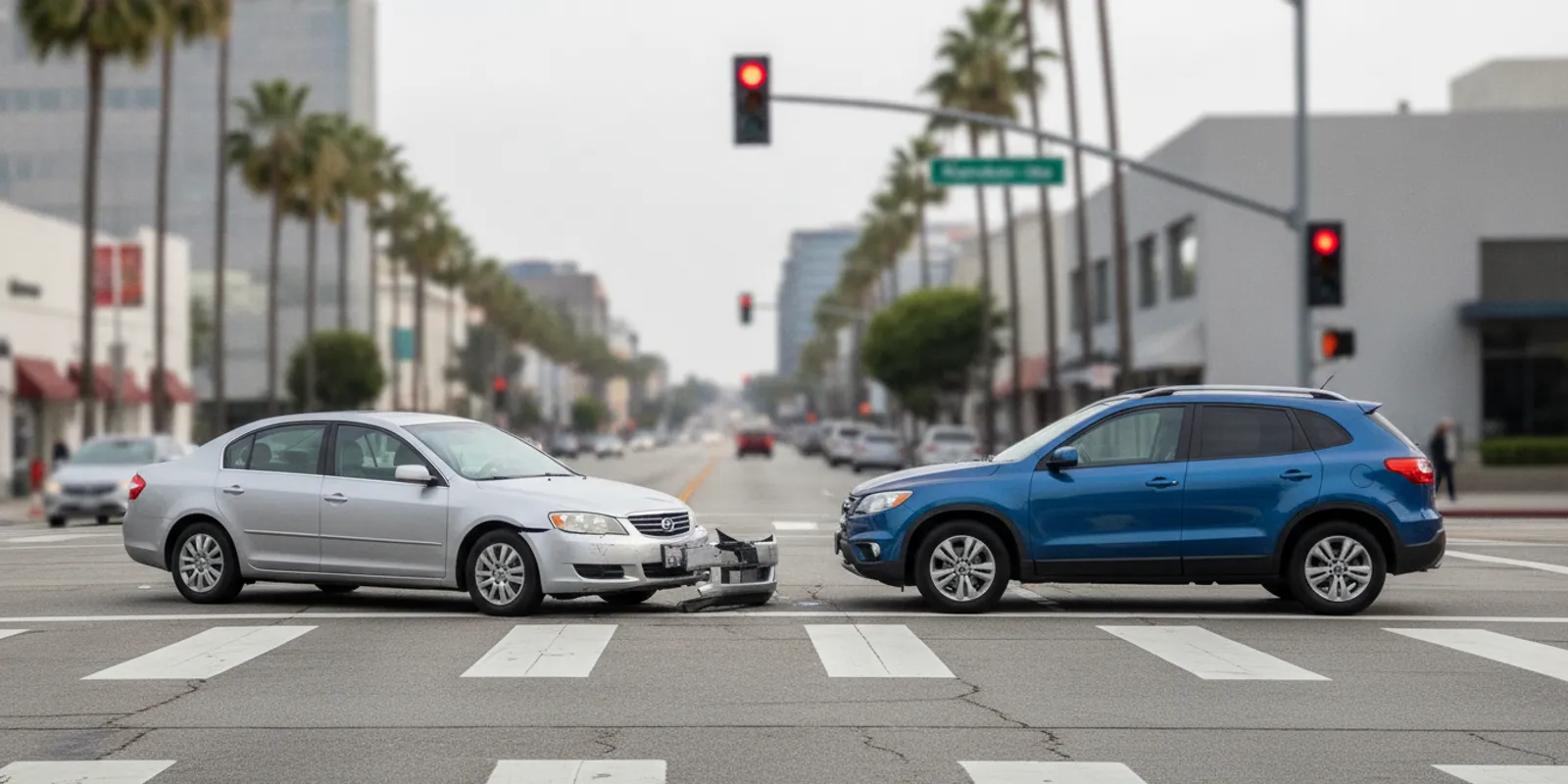
After a crash at a busy crossing, it can be hard to know which driver had the right of way or caused the collision. Intersection accident fault Los Angeles cases turn on the full sequence of events, not just the location of the damage or one driver’s first account. Signal timing, turning movements, speed, visibility, witness observations, and other evidence may all matter. More than one person may share responsibility.
Why can an intersection crash be difficult to sort out?
Several drivers may reach an intersection within seconds of each other. One may be turning left as another continues straight. A driver may enter from a side street, change lanes near the crossing, or proceed after a light changes. Each person may remember the signal differently, particularly when the impact happened quickly or the view was partly blocked.
The vehicles’ final positions can help investigators understand the collision, but they are only part of the picture. A dent on a door does not automatically show who had the right of way. Nor does a driver’s statement that the light was green settle the question on its own. The relevant details include where each vehicle was before impact, which direction it was moving, how quickly it approached, and whether the driver had a reasonable chance to see and respond to a hazard.
Small details can change the interpretation. A car that appears to have entered late may have been moving through the intersection when another driver began a turn. A vehicle photographed near a crosswalk may have moved after impact. A witness standing on one corner may have seen one signal head but not the signal facing the other driver. A careful review keeps observations separate from assumptions.
How is fault considered after a Los Angeles intersection crash?
California applies comparative fault principles. In general, responsibility may be divided if the conduct of more than one person contributed to a collision. A person’s share of responsibility can affect the amount they may recover. The facts and applicable law determine how a particular claim is evaluated, and an insurer’s initial view is not necessarily the final answer.
Right-of-way rules are important, but they do not excuse every other driving choice. A driver with a green light may still need to pay attention to visible hazards. A driver turning left may need to yield to oncoming traffic, while an oncoming driver’s speed, lookout, or response may also be examined. These are not automatic conclusions about a particular crash; they show why the maneuver and surrounding circumstances matter together.
For example, imagine that one driver says they entered on green while another says the light had already changed. A useful review would ask what each person could see, when the vehicles entered the intersection, whether there are witnesses or recordings, and whether the signal sequence can be established. If the available evidence supports more than one account, the uncertainty should be acknowledged rather than filled with guesses.
Which facts may help explain the sequence?
Try to create a clear timeline from the moments before impact through the time the vehicles stopped. A simple written account is often more useful than a collection of photographs with no explanation. Record what you personally remember and mark uncertain details as uncertain.
- Approach and direction: Note the street names, direction of travel, lane, and whether you were going straight, turning, or changing lanes. If you do not know the exact street or lane, describe nearby landmarks without guessing.
- Signal and signs: Write down what signal you saw and where it was located. Note any turn arrow, stop sign, yield sign, lane marking, or signal visibility issue. Do not assume that another signal head displayed the same phase as the one you saw.
- Timing and movement: Describe whether you were stopped or moving, when you began to move, and what you noticed immediately before impact. Estimates such as “a few seconds” should be identified as estimates.
- Visibility and conditions: Record weather, lighting, glare, parked vehicles, construction, foliage, or other obstructions that may have affected what a driver could see.
- Impact and stopping point: Note which parts of the vehicles contacted one another, where debris or marks appeared, and where each vehicle came to rest. Take wide photographs as well as close-ups if it is safe.
- People who saw the crash: Get names and contact information for witnesses if possible. Ask what they observed, not what they think should have happened, and avoid coaching or arguing with them.
Damage location, debris, skid marks, and vehicle positions can provide clues about movement. But a single physical clue may have more than one explanation. For instance, damage on the side of a vehicle may be consistent with a crossing impact, but the damage alone usually cannot establish the signal phase or the actions that led to it. Preserve the original photographs and avoid editing them in a way that removes context.
What evidence should you preserve, and how?
Start with information that may disappear or become harder to obtain. Nearby businesses, residences, transit vehicles, or traffic systems may have cameras, but recordings may be overwritten. If you notice a camera facing the intersection, write down its location, direction, and the time window that may include the collision. Do not assume that it recorded the event or that you can access it yourself; the note simply helps identify a possible source promptly.
Keep the original files from your phone and make a backup. Label copies with the date and location, but do not crop, filter, or annotate the only version. If you photograph the intersection later, make clear that the images were taken later and note anything that has changed, such as construction, parked vehicles, or signal equipment. A later image can show layout, but it does not prove the precise conditions at the time of the collision.
Record the responding agency and any incident or report number. A report may contain statements, scene observations, diagrams, or other useful leads. It is one source of information, not automatically a final legal determination of fault. Read it for factual mistakes, including the direction of travel, vehicle description, or witness details. If you find an error, note the specific passage and the information you believe is accurate.
Save repair estimates and photographs of vehicle damage before repairs when practical. Keep receipts and records connected with the crash, and preserve relevant messages or emails. If a vehicle must be repaired or moved for safety, do not delay necessary action just to obtain photographs; document what you can first if it is safe and feasible. Medical records and notes about symptoms can document the injury and treatment, but they do not by themselves establish who caused the traffic collision.
How can you build a useful written account?
As soon as you are able, write a short account in your own words. Start with the trip and approach: where you were going, the street you were on, your lane, and whether you were stopped or moving. Then describe the signal or sign you saw, the other vehicle’s position, the moment you first noticed a possible danger, the impact, and what happened immediately after. Include the approximate time and weather if you remember them.
Separate direct memory from information learned later. You might write, “I saw the light facing me turn green before I entered,” if that is what you remember. If another person later said the other driver had a red light, identify that as something you were told, rather than presenting it as your own observation. If your memory is incomplete, say so. A precise account of what you do not remember is better than a confident guess.
Keep track of how your recollection changes. If you later remember an additional detail, add a dated note instead of silently rewriting the original account. This creates a clearer record of what you recalled at each stage. Keep the account private and organized with your other documents, and discuss questions about sharing it with an insurer or another party with a qualified professional if you are uncertain.
What should you do in the days after the collision?
- Put safety and urgent needs first. Move away from traffic if it is safe. Call for emergency assistance if anyone may be injured or the scene presents an immediate danger. Do not stand in a live roadway to take pictures.
- Exchange and record basic information. Note the other driver’s name and contact and insurance details, vehicle information, and the responding agency. Avoid debating fault at the scene; focus on safety and accurate information.
- Get appropriate medical care. Explain that a collision occurred and describe your symptoms to a medical professional. Some problems are not obvious at the scene. Follow appropriate medical guidance and keep appointment and treatment records.
- Make a prompt evidence list. Save photographs, witness information, report details, camera locations, and your written recollection. Note anything you still need to obtain. This list can help you follow up before a recording or contact detail is lost.
- Notify your insurer as required by your policy. Give accurate basic information and do not guess when you do not know an answer. Keep a record of the date, the person you spoke with, and what was requested.
- Keep a claim folder. Store correspondence, estimates, medical paperwork, receipts, and notes in one place. Use a simple timeline so you can see what happened and when.
If you did not take photographs at the scene, you still have useful steps available. Write down your recollection, preserve your vehicle and medical documents, identify anyone who may have witnessed the crash, and note nearby camera locations. If another person took photographs, ask whether they can share the original files. Do not assume that missing one type of evidence means there is no way to understand what occurred.
How should you handle insurance questions?
Insurers may speak with drivers and witnesses, review reports and photographs, inspect vehicle damage, and evaluate liability. Their investigation may take time, especially when accounts conflict or more than one vehicle is involved. Different insurers may reach different preliminary views. Ask what information supports a position, what additional information is being requested, and how to provide it accurately.
Keep a communication log with the date, name, company, phone number or email, and a brief summary. Save letters and emails. If a question is unclear, ask for it to be repeated. If you do not know the answer, say that rather than estimating. If you realize you gave an inaccurate detail, make a clear correction and explain the basis for it.
Be careful before agreeing to a recorded statement for another party’s insurer or signing a release. You can ask what the statement or document covers and whether it resolves only one issue or a broader claim. Do not sign something you do not understand. Consider getting legal guidance if the injuries are significant, liability is disputed, multiple insurers are involved, or an offer or release is presented before you understand the extent of the claim.
The general legal process overview explains common stages that may arise in a personal injury matter. A settlement is not simply a figure detached from the facts; the injury information, available evidence, and terms of any proposed release should be understood before making a decision. The firm’s page on what a settlement means offers additional general context.
What if the other driver says you caused the crash?
A disagreement does not by itself determine fault. Avoid responding with speculation, an argument, or an admission you do not believe is accurate. Be truthful and stick to what you know. If you have photographs, a witness, a different recollection of the signal, or information about a blocked view, make sure those details are recorded and preserved.
Ask the insurer to explain the factual basis for its position. Is it relying on a driver’s statement, a report, a photograph, or a particular interpretation of vehicle damage? You can identify information that may be missing or inconsistent. For example, a report may list the wrong direction of travel, or an image may not show the signal that applied to your lane. A specific question is more useful than a general assertion that the conclusion is unfair.
If evidence points to a contribution by more than one driver, comparative fault principles may be relevant. That does not mean a person should accept a percentage based on an unexplained estimate. The significance of each fact depends on the full record and applicable law. Do not assume that a preliminary decision cannot be revisited, but keep communications factual and preserve any new evidence you find.
How do different intersection scenarios change the questions?
Some recurring crash patterns help show which facts may need closer attention. These examples do not determine fault in any individual case; they are prompts for identifying evidence.
- Left-turn and oncoming collision: Clarify where each vehicle was when the turn began, whether the turning driver waited or proceeded, what the signal showed, and how quickly the oncoming vehicle was approaching. Damage patterns and witness accounts may help reconstruct the paths, but neither automatically resolves the signal question.
- Side-street entry: Identify the signs or signals controlling each approach, the point where each vehicle entered, and whether a parked vehicle, building, or other obstruction limited visibility. Note whether a driver stopped and what was visible before entering.
- Rear impact in a queue: Determine whether traffic was stopped, slowing, or moving through the intersection and whether a vehicle was pushed into another vehicle. Record the order of impacts and the position of each car before anyone moves it, when it is safe to do so.
- Lane-change or side-swipe near a crossing: Note lane markings, turn-only lanes, vehicle positions, and whether a driver was preparing to turn. Wide photographs can show how lanes feed into the intersection; close-ups alone may omit that context.
- Crash involving several vehicles: Make a separate list of each vehicle, driver, insurer, and known movement. A sequence can include more than one contact, and a later impact may obscure what happened first. The discussion of multi-vehicle accident claims covers additional issues that can arise when several drivers are involved.
In each scenario, be cautious about assigning meaning to one fact before the sequence is known. A vehicle’s final position may have changed after impact. A driver may have moved a car to clear traffic. A witness may have seen the first contact but not a later one. Recording the source and timing of each detail makes it easier to compare accounts without treating all information as equally direct.
When may a case review be useful?
A case review may be useful when a collision caused a significant injury, the other driver disputes the signal or vehicle movement, a report appears to contain a factual error, several drivers or insurers are involved, or important video may be at risk of being overwritten. It can also help if you are unsure which records to preserve, how to respond to a liability decision, or what a proposed release would cover.
Gather what you have, but do not wait for a perfect file before asking questions. A concise timeline, the report number, photographs, witness details, insurer correspondence, and information about medical care can help frame the discussion. If an item is missing, list it as missing rather than implying that you have it. A case review can help identify questions to investigate; it cannot promise a particular outcome.
The firm’s auto accident practice page describes its personal injury focus, and its Los Angeles location page provides local context. The firm states that it handles personal injury matters on a contingency basis, with attorney fees not charged unless there is a recovery; the terms and any case-related expenses should be discussed for the specific matter. You can also read about the firm’s personal injury practice.
Frequently asked questions
Does the driver who hit the side of my car automatically have fault?
No. The damage location may be one clue about the vehicles’ paths, but it does not automatically establish right of way or responsibility. Signal timing, movements, visibility, witness accounts, and other evidence may matter.
Can both drivers share responsibility?
Yes. California comparative fault principles can allow responsibility to be divided when the evidence indicates that more than one person contributed. The effect on a claim depends on the facts and applicable law.
Is a police report the final decision about fault?
Not necessarily. A report may record useful observations and statements, but it is one part of the available information and is not automatically a final legal finding. Review it for factual errors and preserve other evidence as well.
What if I did not photograph the crash scene?
You can still write down your recollection, preserve vehicle and medical records, ask witnesses for their information, and make a prompt note of possible camera locations. A lack of scene photographs does not mean every other source of information is unavailable.
Should I accept the insurer’s first fault decision?
An insurer’s position is not necessarily the final word. Ask what evidence supports it, identify any specific facts or records that may be missing, and consider legal guidance if the injury or dispute is significant. Do not sign a release until you understand what it resolves.
Take a careful next step
Fault after an intersection crash is assessed from the whole record, not one detail in isolation. Prioritize safety and appropriate care, preserve what you can, keep your account factual, and seek help understanding your options if liability or injury questions remain unresolved.